How Benmax Is Scaling Design In-House
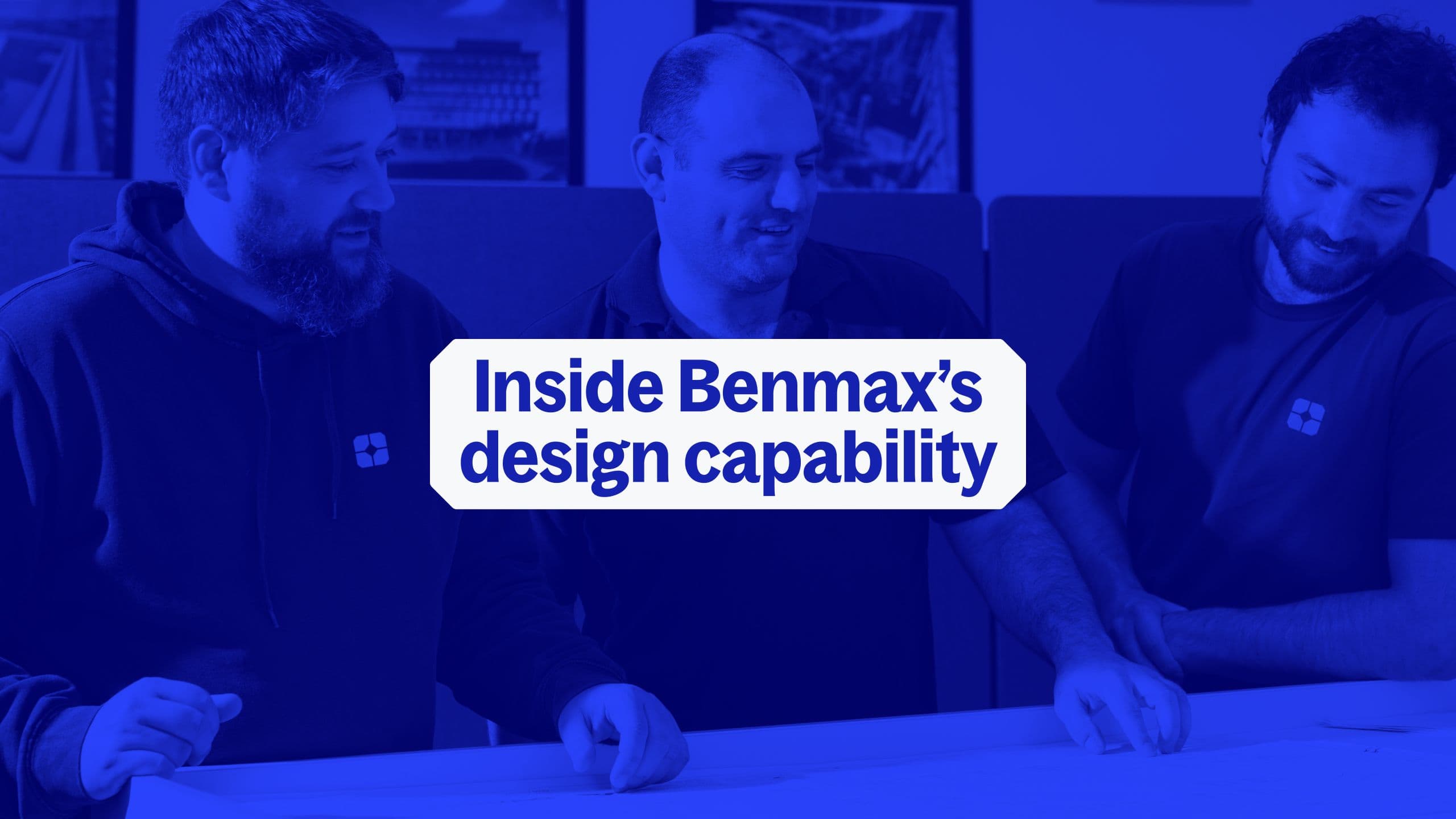
Design Manager Christopher Ward talks about why in-house design is changing the way complex projects get delivered, and what it means for the industry.
The gap in the industry
For years, the standard model was simple: a consultant designs it, a contractor builds it. It worked well enough…until it didn't. Clients began noticing that consultant-led designs, while technically sound, weren't always buildable. The equipment specified didn't necessarily exist, and approaches that looked right on paper started to create problems on-site. By the time those gaps began to surface, the project was already deep into delivery.
"There was often a gap between theoretical design and what could actually be built," says Christopher Ward, Benmax's Design Manager. "Clients started asking for contractor involvement earlier and earlier in the process because they were finding that out the hard way."
Design meets construction
Benmax's response was to build it in-house. The design team — now eight people, including three consulting engineers, three graduates, and two CFD modellers — sits within the broader Benmax business rather than operating as a separate consultancy.
"Our engineers sit next to the people who are going to be installing the systems," Ward says. "If a designer wants to do something a particular way, the person who's going to put it together can say immediately whether that's going to work, not six months down the track.”
Prefabrication by design
That integration flows directly into prefabrication, a significant part of how Benmax delivers projects. When design and construction knowledge work together from the start, large assemblies can be planned for off-site manufacture properly. Built in a controlled environment, installed faster, with better quality control and less exposure on a live building site.
"For clients under program pressure, which is most clients, that matters enormously," says Ward.
BIM, CFD, and AI infrastructure
Technology sits at the centre of how the design team operates. BIM (Building Information Modelling) underpins every project, building a digital twin of the physical asset that gives facility managers visibility over equipment lifecycles, maintenance schedules, and future costs.
More recently, Benmax has invested in CFD (Computational Fluid Dynamics) modelling capability that was previously subcontracted out. With AI infrastructure projects demanding more precise thermal management, the ability to model airflow through a data centre rack by rack, identify hot spots, and optimise systems before construction starts has become a real differentiator.
"There are very few companies that have CFD modelling capability, and they tend to do it broadly," Ward says. "What we've built is a team of CFD engineers who specifically understand mechanical systems. That's a different thing."
On liquid cooling, one of the faster-moving frontiers in data centre design, Benmax's approach is to start with what the chip actually needs and work backwards, rather than fitting an existing product to the brief. It's more work upfront, but it produces systems ready for the next generation of hardware without starting from scratch.
Where it makes a difference
Ward spent 16 years in consulting before joining Benmax; that transition was instructive.
"I thought I had a solid understanding of how things should work. And then I sat next to the people who were actually going to install what I was designing, and I realised pretty quickly that technical correctness and practical reality aren't always the same thing."
That back-and-forth happening every day from the start is what Ward sees as the real advantage. It sharpens the work in ways that don't happen when design and construction are kept separate.
"The designer who sits right next to the person with the hammer is the advantage. I don't think there are many other businesses where you can say that."
To find out more about Benmax's design capability, visit benmax.com.au/design
Interested in joining the Benmax design team? View current opportunities at benmax.com.au/careers